
In Central Vietnam, where a vast area of natural forest remains degraded, finding solutions that simultaneously restore forest ecosystems and generate sustainable livelihoods for local communities is a complex challenge. The Centre for Rural Development in Central Vietnam (CRD)—a non-profit organization affiliated with the University of Agriculture and Forestry, Hue University—has been addressing this issue through its community-based nursery model, bringing new hope to hundreds of forest-dependent ethnic minority households.
Thua Thien Hue province has allocated over 31,600 hectares of natural forest to 80 communities and 225 household groups for management. However, the lack of native seedlings for forest enrichment has posed a significant bottleneck. Recognizing this constraint, CRD launched an initiative in 2021 to support the establishment of community nurseries, enabling local people to produce native tree species and valuable medicinal plants to restore forests while boosting local income.
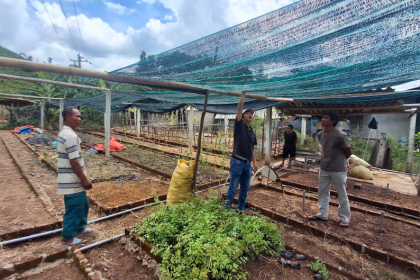
In Thuong Lo commune (Nam Dong district), CRD partnered with a forest protection group of eight households to construct a 1,200 m² nursery equipped with mist-sprinkling irrigation systems, shade houses, and B40 mesh fencing. Within three years, the nursery produced over 12,000 native timber and medicinal seedlings (including Erythrophleum fordii, Scaphium macropodum, wild ginger, and traditional herbal plants). A portion of these seedlings was sold to the Nam Dong District Agricultural Service Centre, generating over VND 20 million in income for the group. The nursery has also become a practical learning site for communities both within and outside the province.
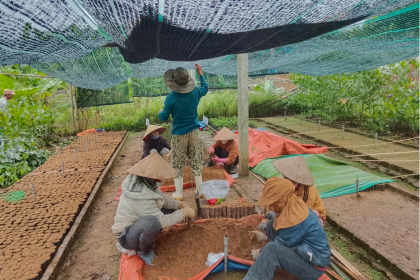
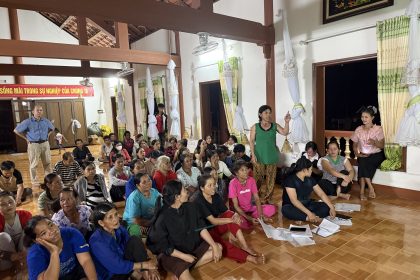
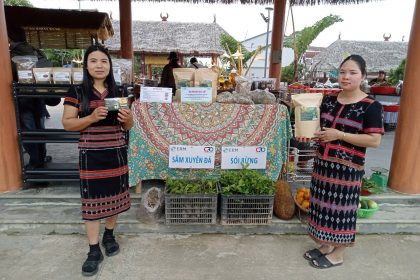
Building on the success in Nam Dong, CRD expanded the model to A Luoi district, homeland to a large population of the Pa Co ethnic minority group. Since April 2024, three community nurseries have been established in Hong Kim, Nham Quang, and Hong Van communes. A key distinction of the A Luoi initiative is female empowerment: local Pa Co women directly lead and manage the nurseries. They received hands-on training in seed propagation, bagging techniques, wild seed collection, and nursery operation. Ranging from 250 to 500 m², each nursery yields between 9,000 and 12,000 seedlings annually, focusing on rare local medicinal species such as Myxopyrum smilacifolium, Sarcandra glabra and Ampelopsis cantoniensis.
In their first year alone, these nurseries produced over 22,000 high-quality seedlings ready for community forest restoration and underbrush planting. Beyond ecological benefits, the nurseries provide stable employment and new revenue streams for Pa Co women, empowering them in forest stewardship and household economic development.
Ms. Ho Thi Giang, leader of the women’s nursery group in Hong Kim commune, shared:
“The project has provided us with new employment and additional household income. Working together at the nursery every day filled with laughter has strengthened our bond and deepened our connection to this work.”
The initial accomplishments of CRD’s community nursery model demonstrate that forest enrichment can effectively align with sustainable livelihood opportunities for ethnic minorities, particularly women who traditionally have limited access to forestry-based economies. This initiative stands as a testament to the “conservation linked with livelihoods” approach that CRD has championed for nearly three decades.